
Arkansas Criminal History Checks
Start by deciding what the Arkansas record must answer. Arkansas Criminal History Search, or ARCH, is the open name-based state product. It includes Arkansas felony and misdemeanor convictions, open felony arrests less than three years old, and registry status. It does not include active warrants, dismissed charges, unresolved misdemeanor arrests, old open felony arrests, traffic history, federal or out-of-state records, non-fingerprinted arrests, or sealed cases. A blank ARCH result is therefore narrow. It is not proof that no court, booking, or police record exists.
Search ARCourts supplies the Arkansas case story. Arkansas county clerks hold the official file. Arkansas arresting agencies keep their own reports, and county jails keep booking and release data. ACIC personal review is the right route for a person checking the Arkansas central record tied to their own identity. The Arkansas State Police fingerprint network and the FBI subject-only review offer stronger identity matching when a name can collide.
- Search Search ARCourts for filed charges, docket events, and the final outcome.
- Confirm the county, court, date of birth, and case number before relying on a match.
- Use ARCH only for its defined statewide criminal history result and read every exclusion.
- Open the county source for the official court file, recent booking, or arrest report.
- Use personal review or an authorized fingerprint path when identity certainty matters.
Note: A court docket, booking sheet, and ACIC entry can all be accurate while showing different stages of the same Arkansas event.
Arkansas Criminal History Has Four Records
A single Arkansas arrest can create four separate Arkansas files. The officer's agency writes an Arkansas incident or arrest report. A county detention center makes the booking log and takes fingerprints for qualifying events. An Arkansas prosecutor may then file a case, which produces a court docket and judgment. Finally, fingerprints and later disposition data can reach ACIC's Computerized Criminal History repository. Each Arkansas custodian owns its part.
This Arkansas split prevents a common mistake. An Arkansas booking charge is the allegation recorded at intake, not the charge a prosecutor finally files. A case marked closed does not say whether each count ended in conviction, dismissal, acquittal, or another disposition. The ACIC rap sheet is a compiled Arkansas identity record, not the full county case file. Read each source for the question it was built to answer.
| Arkansas Record | Primary Custodian | Best Use |
|---|---|---|
| Incident or arrest report | Arresting agency | Event narrative and report details |
| Booking record | County jail | Intake charge, bond, custody, and release |
| Criminal case file | Circuit or district clerk | Filed counts, docket, disposition, and judgment |
| Criminal history cycle | ACIC | Fingerprint-linked statewide compilation |
The Criminal History Repository in Arkansas
The Arkansas Crime Information Center, or ACIC, administers the central Computerized Criminal History system within the Department of Public Safety. Arkansas State Police Identification Bureau handles the public check and fingerprint-processing channels. This division of work matters. ACIC maintains the repository and its forms, while ASP provides ARCH, the controlled CBC system, certified-result routes, and fingerprint services.
Covered Arkansas arrests enter through fingerprints and an Arrest Tracking Number. Arkansas courts later report the disposition. ARCH warns that an Arkansas felony conviction will not appear if the sentencing court has not supplied timely and accurate data. ACIC's 2024 workload shows the Arkansas scale: 89,046 criminal-history records entered, 61,182 judgments entered, 98,399 judgments verified, and 3,763 ACIC or NCIC corrections based on arresting-agency requests. Those figures describe work, not a completeness rate.
The specialized ACIC criminal history checks page compares every state product, fee, fingerprint path, personal review step, and county-file fallback.
Search Arkansas ARCH Carefully
ARCH charges $24 before a result is known. The price covers the search and one viewed possible match. Each extra possible-match result viewed costs another $24. A common name can therefore make exact data important. Payment is by card, the fee is nonrefundable even when no subject is found, and the result arrives as a PDF through a time-limited email link. Keep both the receipt and PDF.
The official ARCH service page is the source for its current fee, search rules, and statutory limits.
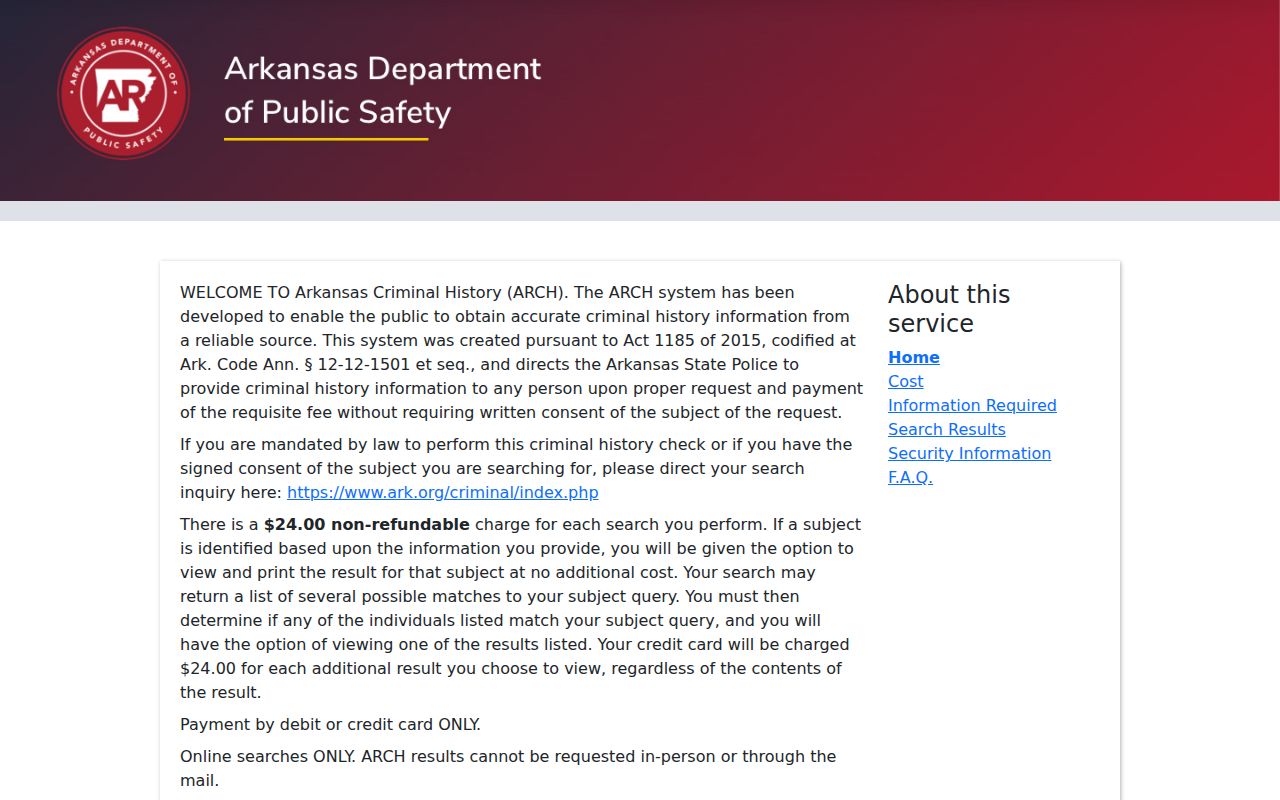
The Arkansas service requires exact identity details and makes clear that its Arkansas criminal history result is not a complete account of every Arkansas arrest, warrant, or county case.
| ARCH Field | Required | Search Detail |
|---|---|---|
| Email and payment | Yes | Receipt and time-limited PDF link go to email |
| First name | Yes | Use the legal first name |
| Last name | Yes | Exact spelling matters |
| Sex | Yes | Required matching choice |
| Date of birth | Yes | Full date including year |
| Race or ZIP | No | May help distinguish possible matches |
Record Systems Across Arkansas
Arkansas record systems do not overlap perfectly. Search ARCourts indexes public Arkansas court information. The ADC locator is for Arkansas correctional custody, not each county jail. The Arkansas sex offender system publishes the state-authorized public registry view, not the full registration file. ARCH supplies only the public Arkansas criminal history subset set by statute. Arkansas county agencies remain essential for original records and certified copies.
The Search ARCourts interface demonstrates the statewide court-search layer that replaced Public CourtConnect.
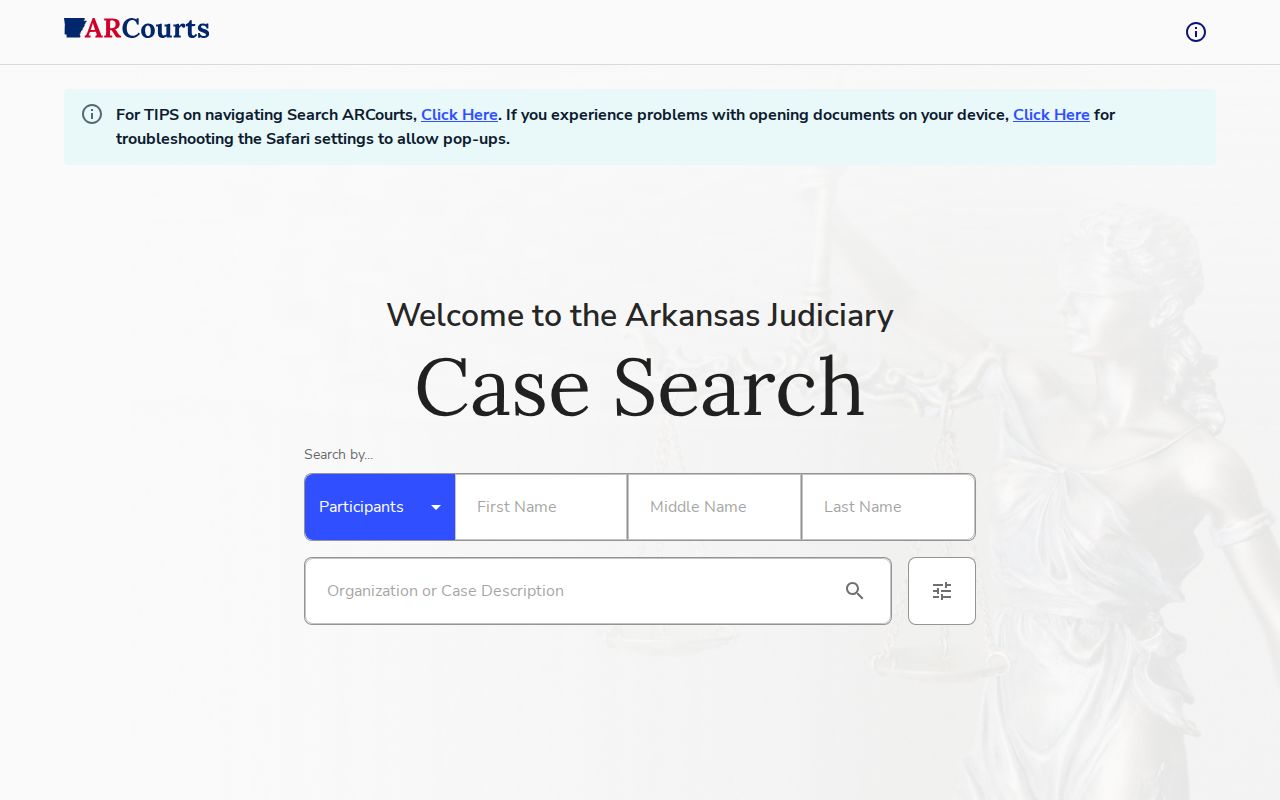
Its filters help locate circuit cases across all counties, but online district-court coverage is partial and the clerk remains the official file source.
| System | What It Holds | Run By |
|---|---|---|
| ARCH | Defined conviction, recent open-felony, and registry result | Arkansas State Police and ACIC |
| Search ARCourts | Public docket, charge, event, and disposition data | Arkansas Judiciary |
| ADC Inmate Search | State correctional custody and public sentence fields | Arkansas Department of Corrections |
| Sex Offender Notification System | Publishable registry profiles, map, and alerts | ACIC |
| Arkansas VINE | Participating custody and supervision notifications | Arkansas justice partners |
Arkansas Fingerprints Follow Two Paths
Arkansas does not use one exclusive statewide fingerprint vendor. Arkansas State Police authorizes electronic Harvester and LiveScan operators. An Arkansas Harvester can begin an authorized state or federal transaction and capture and transmit fingerprints. An Arkansas LiveScan operator may capture and submit prints but may not initiate the check. ASP headquarters no longer performs civil-applicant fingerprint capture, so the current Arkansas operator list controls location and appointment details.
For one's own Arkansas central record, use the ACIC Authorization for Review. The official form is notarized and states no review fee. For an FBI Identity History Summary, the subject orders through the FBI electronic channel, pays the current $18 federal fee, and follows the fingerprint submission instructions. A fingerprint match resolves identity. It does not replace the county court's judgment or correct that judgment by itself.
Note: Confirm the transaction code, identification, appointment, capture price, and recipient before visiting an Arkansas fingerprint operator.
Arkansas Criminal Record Types
Arkansas criminal records track different acts and decisions. An Arkansas arrest report records why an officer acted. An Arkansas booking log tracks detention. An Arkansas court file shows what prosecutors filed and how each charge ended. An ACIC record compiles Arkansas fingerprint-linked cycles. An Arkansas warrant is a court command, while a registry profile is a public safety notification record. Probation and post-prison transfer records describe Arkansas supervision after a court or release decision.
- Arrest and booking records: county and city agencies create the recent custody trail.
- Court case records: clerks maintain filed counts, hearings, dispositions, and judgments.
- Repository records: ACIC compiles covered fingerprint events and reported outcomes.
- Warrants: the issuing court and local law enforcement hold current status.
- Custody and supervision: ADC, VINE, local jails, and court dockets answer different status questions.
- Registry records: ACIC and local registering agencies manage risk-based public notification.
- Disposition
- The outcome of one charge, such as conviction, dismissal, acquittal, or nolle prosequi.
- Rap sheet
- A compiled criminal history organized by identity and fingerprint-linked arrest cycles.
- ATN
- The Arkansas Arrest Tracking Number connecting one arrest event to later court data.
- Sealing
- Arkansas relief that restricts ordinary public access without promising destruction of every justice-agency record.
Arkansas Custody Records Update Differently
A recent Arkansas booking belongs first to the county jail. A person sentenced to ADC custody may remain in county backup status before physical transfer. The Arkansas Department of Corrections Inmate Search then becomes the state-custody source. Federal imprisonment is separate and belongs in the Bureau of Prisons locator. None of those systems substitutes for the Arkansas court case.
Arkansas VINE publishes a useful timing distinction. Participating county-jail information refreshes about every 15 minutes, ADC data about hourly, and court or supervision information daily. A valid county roster and a valid ADC or VINE entry may therefore disagree for a short time. Treat the newest official source as a status lead, then confirm urgent bond, release, or hearing questions with the responsible office.
Custody flow: County booking → local court process → possible ADC transfer → state custody or community supervision.
Arkansas Warrants Lack One Search
Arkansas has no comprehensive public statewide warrant portal. ACIC and NCIC hold restricted law-enforcement data, and ARCH explicitly excludes active warrants. Public checks must follow the issuing court and county. Circuit warrants may appear through a circuit docket, while traffic, fine, ordinance, and failure-to-appear matters can sit in state or local district court and may be absent from Search ARCourts.
To resolve one's own possible Arkansas warrant, identify the Arkansas county and court from a citation or case number. Search the Arkansas public docket for clues. Then contact the exact clerk or sheriff warrant line and ask about the warrant type, status, bond, appearance process, and whether court or counsel action is needed. Do not rely on a third-party list or arrive at an office based only on an old web entry. Clearance can lag after Arkansas court action, so confirm both court and law-enforcement systems update.
Arkansas Record Access Laws
The Arkansas Freedom of Information Act generally lets Arkansas citizens inspect and copy Arkansas agency records, subject to exemptions and reasonable reproduction rules. That law does not open every Arkansas system. Arkansas court access follows Administrative Order 19. ACIC dissemination follows narrower Arkansas criminal-history statutes. Juvenile, sealed, victim, medical, identifying, and undisclosed-investigation material can remain restricted. The correct Arkansas request goes to the custodian that created the record.
The Arkansas Attorney General FOIA guidance is a practical source for public-record rights and limits.
Agency reports can be requested under Arkansas FOIA even when restricted ACIC or NCIC query data from the same event cannot be released as an ordinary record.
The Arkansas General Assembly code and acts search is the official starting point for checking current statutory language.
Current code text should control whenever an older form, summary, or portal notice uses different wording.
Key Arkansas authorities:
Ark. Code Ann. § 25-19-105 gives the public inspection and copying rule, with exemptions.
Ark. Code Ann. § 12-12-1501 et seq. creates the limited public ARCH product.
Ark. Code Ann. § 12-12-1009 limits criminal-history dissemination.
Ark. Code Ann. § 16-90-1401 et seq. governs adult record sealing.
Arkansas Sealing Starts in Court
Arkansas calls its main adult record-clearing remedy sealing. The Arkansas process starts in the county court that handled the offense, not at ACIC. Arkansas eligibility changes with the offense, outcome, sentence completion, earlier record, and statutory program. Arkansas Act 346 is a major first-offender route, and specialty courts have their own form sets. ACIC posts Arkansas petitions and orders but says it cannot select the right form for a requester.
- Identify the exact Arkansas court, case number, final disposition, and statutory route.
- Use the correct petition and order forms, then file in the court that handled the matter.
- Provide prosecutor notice and complete any hearing or service requirements.
- Keep certified copies of the signed, filed sealing order.
- Verify the clerk, arresting agency, ASP or ACIC, and public portals process the order.
ACIC says Arkansas law allows it 30 days to process a properly filed order. In 2024 it entered 4,071 sealing orders. If a matter remains visible later, obtain the filed order from the sentencing clerk and use ACIC personal review or correction steps. Sealing limits public access, but it does not guarantee physical destruction or erase every authorized use.
Arkansas Felony and Supervision Records
Arkansas felony classes run from Class D through Class Y. Class Y carries 10 to 40 years or life, while Class A carries 6 to 30 years, Class B 5 to 20 years, Class C 3 to 10 years, and Class D up to 6 years under the general imprisonment statute. Class Y is not another name for capital felony. Offense-specific law can control, so the filed statute and judgment matter more than a short portal label.
Arkansas Circuit Courts have exclusive original felony jurisdiction and concurrent misdemeanor jurisdiction. Arkansas District Courts handle misdemeanors, violations, traffic matters, and preliminary felony functions. Arkansas probation is imposed by a court. The ADC Division of Community Correction supervises Arkansas probationers, parolees, and post-release populations through area offices. The Arkansas Post-Prison Transfer Board makes covered release decisions. The sentencing county docket remains the source for the Arkansas sentence and any revocation action.
VINE can show supervision type, office, and selected status events. ADC publishes a standard $35 monthly supervision fee, though vendor transaction charges may be added. A public status feed is not the confidential officer case file.
Arkansas Federal Records Live Elsewhere
Search ARCourts does not hold federal cases. Arkansas is divided between the Eastern and Western U.S. District Courts, and federal dockets use PACER rather than an Arkansas portal. The FBI Identity History Summary is a subject-only fingerprint review of FBI-maintained history, not the Arkansas repository. Federal prison custody uses the Bureau of Prisons locator. A federal detainee can also be held in an Arkansas contract county facility before sentencing, so custody systems may need to be checked together.
PACER's 2026 price is $0.10 per page with a quarterly waiver when total charges are $30 or less, and most documents have a $3 cap. Those amounts are scheduled to change in 2027. RECAP can provide free user-contributed copies, but PACER and the district clerk remain authoritative. Sealed federal material does not become public because an Arkansas state portal is open.
Arkansas Criminal Record Fees
Arkansas charges differ by product. A fee buys access to that channel only. It does not make the result broader than the law allows. County clerk certification, local copying, and fingerprint capture can add costs that have no single statewide amount. Confirm current prices before ordering.
| Arkansas Channel | Published Fee | Key Limit |
|---|---|---|
| ARCH public search | $24 | Nonrefundable; one viewed match included |
| CBC state name check | $22 | Account plus consent or legal authority |
| CBC mail request | $25 | Use current ASP form and instructions |
| FBI personal summary | $18 | Capture or channeler charges may be extra |
| Online crash report | $25 | Involved-party mail route is $10 |
| FOIA inspection | Free | Copies and special electronic work may cost |
Arkansas Criminal Records by County
County selection is not a minor filter in Arkansas. The local clerk, jail, sheriff, and arresting agency hold the original records that statewide systems summarize. Pulaski, Benton, Washington, Faulkner, Saline, Sebastian, Craighead, and Garland are the most populous county record hubs. Ten Arkansas counties also have two seats, so the correct district or courthouse can matter as much as the county name.
The Association of Arkansas Counties directory is the source used to verify county seats and statewide routing.
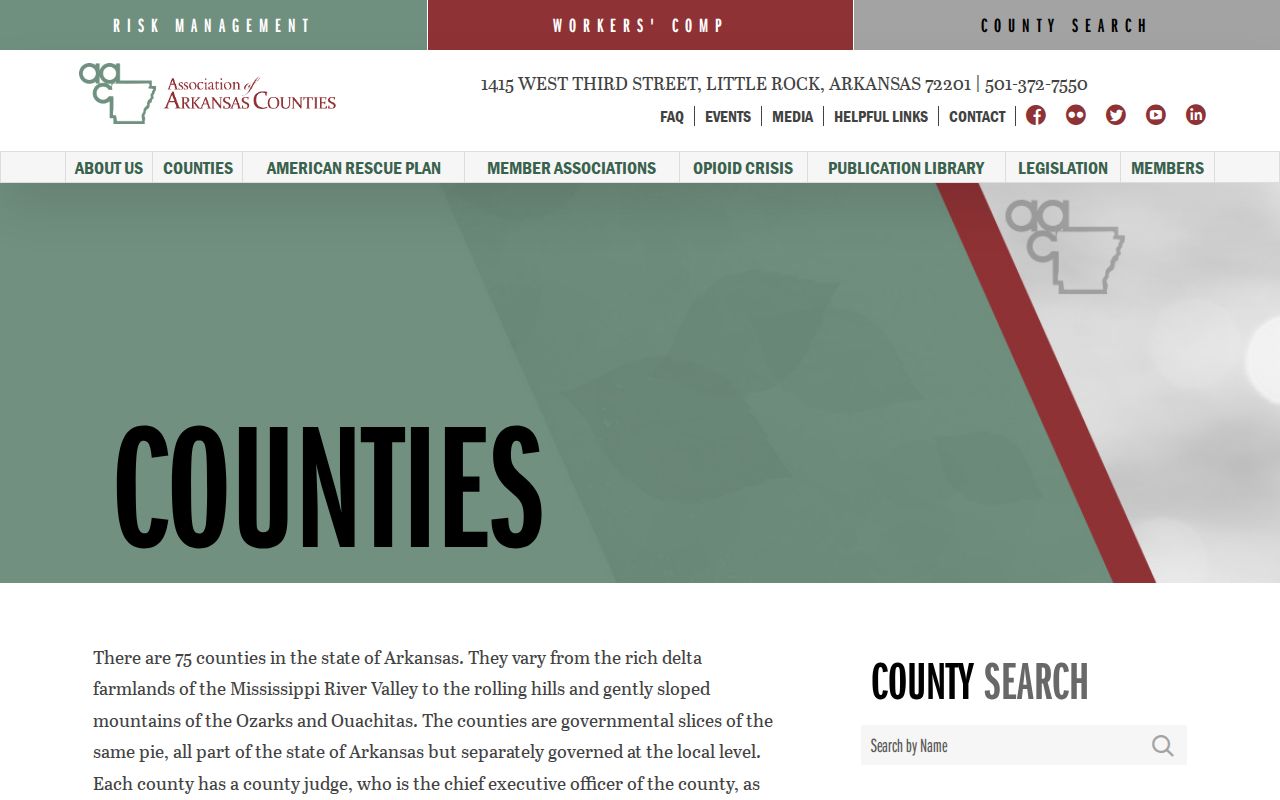
The county layer leads to local arrest reports, jail rosters, warrant contacts, district departments, and certified court files across all 75 jurisdictions.
Pulaski County
Little Rock · largest county and state-capital records hub
Benton County
Bentonville · northwest Arkansas court and sheriff hub
Washington County
Fayetteville · major regional court and custody system
Faulkner County
Conway · central Arkansas court and custody corridor
Saline County
Benton · fast-growing central Arkansas jurisdiction
Sebastian County
Fort Smith / Greenwood · western Arkansas records hub
Craighead County
Jonesboro / Lake City · northeast Arkansas docket hub
Garland County
Hot Springs · central-southwest records jurisdiction
Browse the full directory of all 75 Arkansas counties to open the criminal records site for any county.