
The ACIC Repository at a Glance
The Arkansas Crime Information Center sits within the Arkansas Department of Public Safety's Crime Information Support structure. ACIC administers the Arkansas Computerized Criminal History repository and the secure Arkansas criminal-justice network. The Arkansas State Police Identification Bureau handles Arkansas public checks and fingerprint processing. That Arkansas division of labor matters. ACIC's forms page says ACIC itself does not provide background checks and routes requesters to the correct State Police product.
ACIC's Arkansas repository contains fingerprint-linked felony and Class A misdemeanor arrest records plus judicial dispositions reported by Arkansas courts. The Arkansas agency also supports criminal-justice network access, ACIC/NCIC security and training, Arkansas crime statistics, and the statewide Arkansas sex offender registry. In 2024, ACIC reported 89,046 Arkansas history records entered, 61,182 judgments entered, and 4,071 sealing orders entered. These are Arkansas workload totals, not a completeness rate.
ACIC Criminal History Through Time
Arkansas created the Criminal Justice and Highway Safety Information Center through Act 286 of 1971. The center moved to the earlier Department of Public Safety in 1975. Act 375 of 1979 gave it the Arkansas Crime Information Center name. When the earlier DPS was abolished, Act 45 of 1981 made ACIC a separate agency. Act 1109 of 1993 then authorized ACIC to administer the Computerized Criminal History Record System.
Later Arkansas milestones explain today's products. The Arkansas Sex Offender Registration Act of 1997 placed registry administration with ACIC. Arkansas Act 1185 of 2015 created the public dissemination framework now implemented as ARCH. Current Arkansas reorganization again places ACIC in the Department of Public Safety. Across those changes, Arkansas kept a split model: ACIC maintains central Arkansas information systems, while State Police delivers the main public and authorized criminal history check services.
Note: ACIC maintains Arkansas systems, while State Police operates the principal public check and fingerprint channels.
What Checks ACIC Offers
Arkansas offers several criminal history products, but Arkansas State Police operates their request channels. ARCH is the open Arkansas adult name search. CBC is the controlled Arkansas system for signed-consent or legally authorized checks. Arkansas fingerprint transactions use ASP-authorized Harvester or LiveScan operators. A subject reviews an Arkansas ACIC record through the Authorization for Review process. Certified Arkansas State Police results are requested in person or by mail because ARCH does not issue certified copies.
| Product | Who May Order | What It Returns | Cost |
|---|---|---|---|
| ARCH Arkansas open name search | Any requester searching an Arkansas adult | Defined Arkansas convictions, recent open felony arrests, and registry status | $24; each extra match viewed is $24 |
| CBC Arkansas name check | Requester with signed consent or Arkansas statutory authority | Arkansas result for the authorized transaction | $22 online; $25 mail |
| CBC FBI fingerprint component | Only an Arkansas transaction authorized by state or federal law | Authorized national fingerprint result | $13; $11 volunteer rate, subject to announced change |
| Personal ACIC record review | The Arkansas record subject | The person's Arkansas ACIC history for review and challenge | No fee stated on the official review form |
| Certified ASP result | Requester who needs certification | Certified result unavailable through ARCH | Current fee not stated on ARCH |
The Arkansas State Police CBC portal publishes product choices and current fee information.
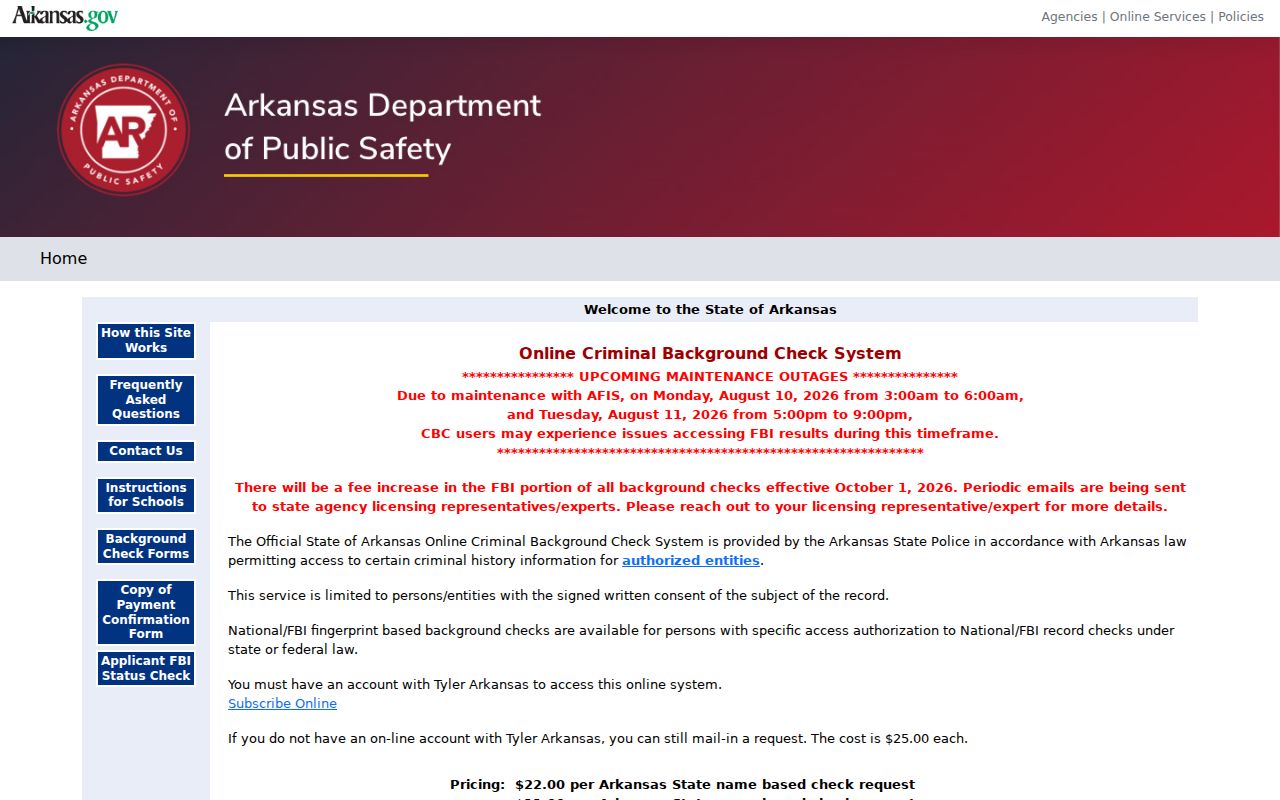
The portal's transaction-based design reflects that Arkansas checks differ by legal authority and source data.
The Path Into the ACIC Repository
An Arkansas criminal history cycle starts with an Arkansas arresting agency. Covered Arkansas felony and qualifying misdemeanor fingerprints must reach the Arkansas State Police Identification Bureau within 48 hours. An Arkansas Arrest Tracking Number links that arrest and its charges to later Arkansas court action. It is different from the person-level Arkansas state identification number. Prosecutors decide what to file, and the correct Arkansas clerk creates the court case.
Data flow: County Arrest › Fingerprint Submission › Arkansas Crime Information Center › Court Disposition Reporting › Rap Sheet
The Arkansas sentencing court sends the disposition to ACIC. A missing or late Arkansas report can leave the repository behind the county file. Name variations, an incorrect birth date, an arrest without fingerprints, and sealed or excluded outcomes can also change the Arkansas result. ACIC's 2024 Arkansas report recorded 462 missing-ATN instances and 451 court submissions returned because the record was not in the system. These counts show real Arkansas reconciliation work without proving a statewide error rate.
ACIC Criminal History Reporting Gaps
ARCH warns that an Arkansas felony conviction will not appear unless the sentencing court supplies timely and accurate disposition data. This is a key Arkansas limit. ACIC compiles what authorized Arkansas agencies and courts transmit; it does not create the original judgment. An Arkansas public repository result, a Search ARCourts docket, an arrest report, and a jail booking can disagree because each records a different Arkansas stage and receives updates on a different schedule.
When an ACIC entry lacks an outcome, find the Arkansas county and case number. Obtain the court's official disposition, then use ACIC's personal review route if the central record is wrong. A public search should not be treated as proof that no county case exists. Act 1185 created a limited public product, not open access to the complete ACIC rap sheet.
Note: A county judgment can be correct even while its matching ACIC disposition is delayed or absent.
ACIC Check Ordering Steps
Start with the Arkansas purpose and record subject. Use ARCH for its narrow public Arkansas adult name result. Use CBC only with the signed consent or Arkansas statutory basis its transaction requires. Choose ACIC personal review to inspect your own Arkansas central record. Use an authorized Arkansas fingerprint channel when the governing process calls for identity certainty. The selected Arkansas transaction controls the form, reason code, fee, recipient, and delivery route.
- Select ARCH, CBC, personal review, certified result, or an authorized fingerprint transaction.
- Gather exact identifiers, consent, authorization, and fingerprints required for that product.
- Submit online, through the current mail form, or through an approved electronic operator.
- Pay the published fee and save the receipt, reference number, and downloadable result.
- Read the inclusion limits, then obtain the county court file for any entry needing detail.
Arkansas ARCH takes payment and email information before exact legal first and last name, sex, and full date of birth. The $24 Arkansas charge is nonrefundable even when no subject is identified. The Arkansas PDF link is time-limited. The manual $25 consent-based Arkansas check uses a notarized form and stamped return envelope; published processing is generally two to five business days after receipt.
ACIC Fingerprints Through Arkansas State Police
Arkansas does not use one exclusive statewide fingerprint vendor. State Police authorizes electronic Harvester and LiveScan operators that submit to ASP AFIS. A Harvester can start the relevant state or federal transaction and capture and transmit prints. A LiveScan operator may only capture and transmit. State Police says headquarters no longer performs civil-applicant printing, so users should consult the current approved-operator list.
Before visiting an operator, confirm the appointment, photo identification, payment, reason or transaction code, and whether electronic submission or cards are needed. Capture prices are set by operators. If the prints reject, follow the resubmission instructions and keep the transaction number. An FBI subject-only Identity History Summary is a separate federal review with its own ordering and fingerprint rules.
Comparing ACIC and County Records
An ACIC criminal history compiles eligible events reported from across Arkansas. The county holds the source material: arrest reports, bookings, filings, docket entries, orders, and certified judgments. Neither replaces the other. The repository is useful for a statewide view. The county file gives the case story and may show a fresh event before its state update. Use the Arkansas county directory for that local half.
| ACIC Check | County Records | |
|---|---|---|
| Coverage | Eligible reported events from all 75 Arkansas counties | Arrests and cases created in one county |
| Source | Fingerprint-linked compiled criminal history | Original court, jail, and agency records |
| Freshness | Depends on agency and court reporting | Updated as the local event or case moves |
| Detail | Summary cycles within product limits | Docket events, filings, orders, and copies |
| Best for | Defined statewide review | Understanding and certifying a specific event |
Note: The ACIC compiled record and the Arkansas county source file answer different but related questions.
ACIC ARCH Is a Limited Product
ARCH can return an identified subject with history, an identified subject without history, or no subject identified. Its public result includes Arkansas felony and misdemeanor convictions, open Arkansas felony arrests less than three years old, and registry status. It excludes juvenile matters, dismissed charges, unresolved misdemeanor arrests, older open felony arrests, acquittals, warrants, sealed matters, pardoned convictions, traffic history, federal and out-of-state history, and non-fingerprinted arrests.
Those exclusions make the words "no subject" and "no history" narrow product outcomes, not promises of a complete life record. A name can also collide with another person. Exact name, sex, and date of birth improve the search, while fingerprints provide stronger identity certainty. Search ARCourts and the correct clerk remain necessary for a public case and its documents.
ACIC Criminal History Access Boundaries
ACIC data does not follow the same access rules as an ordinary local public record. Ark. Code § 12-12-1009 limits criminal history dissemination to authorized channels. Act 1185's public framework, codified at § 12-12-1501 and following sections, permits the defined ARCH result. It does not open the entire Computerized Criminal History file. Local law enforcement also may not run ACIC or NCIC checks for a member of the public simply on request.
Arkansas Freedom of Information Act requests still apply to many records held by their creating agencies, subject to exemptions. That can include an arrest report or administrative record from the proper custodian. FOIA does not override ACIC dissemination law, court confidentiality, sealing, victim protections, or active-investigation limits. Use the channel built for the record: ACIC review for your central file, ARCH for its public subset, the clerk for the court file, and the originating agency for its report.
ACIC Updates After Arkansas Sealing
Arkansas calls the main adult record-clearing process sealing. The filing begins in the court that handled the offense under the Comprehensive Criminal Record Sealing Act and any program-specific rule. ACIC hosts several petition and order sets, but it will not choose the correct one for a requester. Eligibility can change with the offense, sentence, prior record, and route such as Act 346 or a specialty court.
After a proper sealing order is filed, ACIC says Arkansas law allows 30 days to process it. Keep certified copies. Confirm that the clerk, arresting agency, State Police, ACIC, and public portals named in the process receive or reflect the update. In 2024, ACIC entered 4,071 sealing orders and returned 451 court submissions because no matching record was in the system. If a matter remains visible, use the signed order and personal-review process. Sealing limits ordinary access, but it does not promise physical destruction or invisibility for every authorized purpose.
ACIC Record Error Corrections
Use ACIC's Authorization for Review of Criminal History Information to inspect your own central record. The official authorization is notarized, and the form states there is no review fee. Compare each arrest cycle and disposition with the originating court. Common issues include a missing final disposition, an identity mismatch, a wrong personal detail, or a matter that should have been updated after a sealing order.
- Submit the current ACIC personal-review authorization with the identification steps on the form.
- Compare each arrest and disposition line with the official county court file.
- Obtain correct source documents from the court and have them supplied to ACIC.
- Confirm the update through a fresh personal review and keep the source records.
ACIC cannot rewrite a county judgment based only on a requester's statement. The originating court must correct its source record first. Review questions go to the Administrator of the ACIC Criminal History Division at 501-682-2222. If identity is the issue, fingerprint comparison is conclusive.