
Arkansas Sex Offender Checks
The Arkansas Sex Offender Notification System is ACIC's statewide Arkansas public registry. It implements the disclosure part of the Arkansas Sex Offender Registration Act of 1997. It is not a general criminal-case search. ACIC publishes eligible Arkansas registry information received from Arkansas registering agencies. Local Arkansas law enforcement registers people, verifies details, and handles community notice. The free Arkansas public portal offers name, map, and notification paths after the user accepts its conditions.
An Arkansas registry result needs context. The underlying Arkansas registration database is broader than the profiles posted on the public web. Level 3 and Level 4 registrants form the main Arkansas public group. Only a defined subset of Level 2 registrants is posted statewide. A person can have an Arkansas duty to register without a public profile. For the Arkansas court record behind a listing, use Search ARCourts and the county clerk. For current compliance, use the local registering agency.
Arkansas Registry Visibility Limits
Arkansas risk levels guide community notice. They do not act as simple web-display switches. Level 1 means low risk and limited notice. Level 2 means moderate risk. ACIC publicly posts the statutory Level 2 subset involving an adult offender and a victim age 14 or younger. Levels 3 and 4 receive broad notice. Local agencies hold registration details that the statewide public portal does not show.
This Arkansas publication split explains why a missing Arkansas sex offender profile proves little by itself. It may reflect the person's Arkansas assessment level or another publication rule. It does not confirm that no registration exists. Questions about an expected Arkansas listing belong with ACIC or the registering agency. The Arkansas county directory routes local registration and compliance questions to the right county layer.
Note: Public web visibility and the legal duty to register are separate questions under Arkansas law.
Arkansas Sex Offender Registry Search Steps
Open the Arkansas ACIC portal and accept the conditions. An Arkansas name search requires Gender and at least one name field. The Arkansas map path uses a street address and city or place. Results can display as a map or list. Treat an Arkansas map pin as geocoded reported information, not a live location. Confirm a likely match with the photo, aliases, birth date, physical traits, address, and offense details that the profile provides.
- Choose Name Search, Map Search, or Notifications after accepting the registry conditions.
- Enter a first or last name with Gender, or enter a complete address for a place-based search.
- Open each possible profile and compare several identifiers. Do not rely on a name alone.
- Record the search date, then enroll for verified email alerts if ongoing address awareness is useful.
| Field Label | Type | Required | Notes |
|---|---|---|---|
| Arkansas Conditions | Acknowledgement | Yes | Acceptance is retained by cookie for about 24 hours. |
| First Name | Text | Conditional | First or last name is required; nonalphabetic marks are stripped. |
| Last Name | Text | Conditional | Use the known spelling and review aliases on profiles. |
| Gender | Dropdown | Yes | Male, Female, or Unknown. |
| Street Address and City | Geocoded text | Map path | Results follow visible map bounds, not a fixed radius. |
| Email, Address, Radius | Alert enrollment | No | Track up to 10 addresses at 1/4, 1/2, 1, or 2 miles. |
The official ACIC registry interface shows how Arkansas separates identity search from place-based awareness.
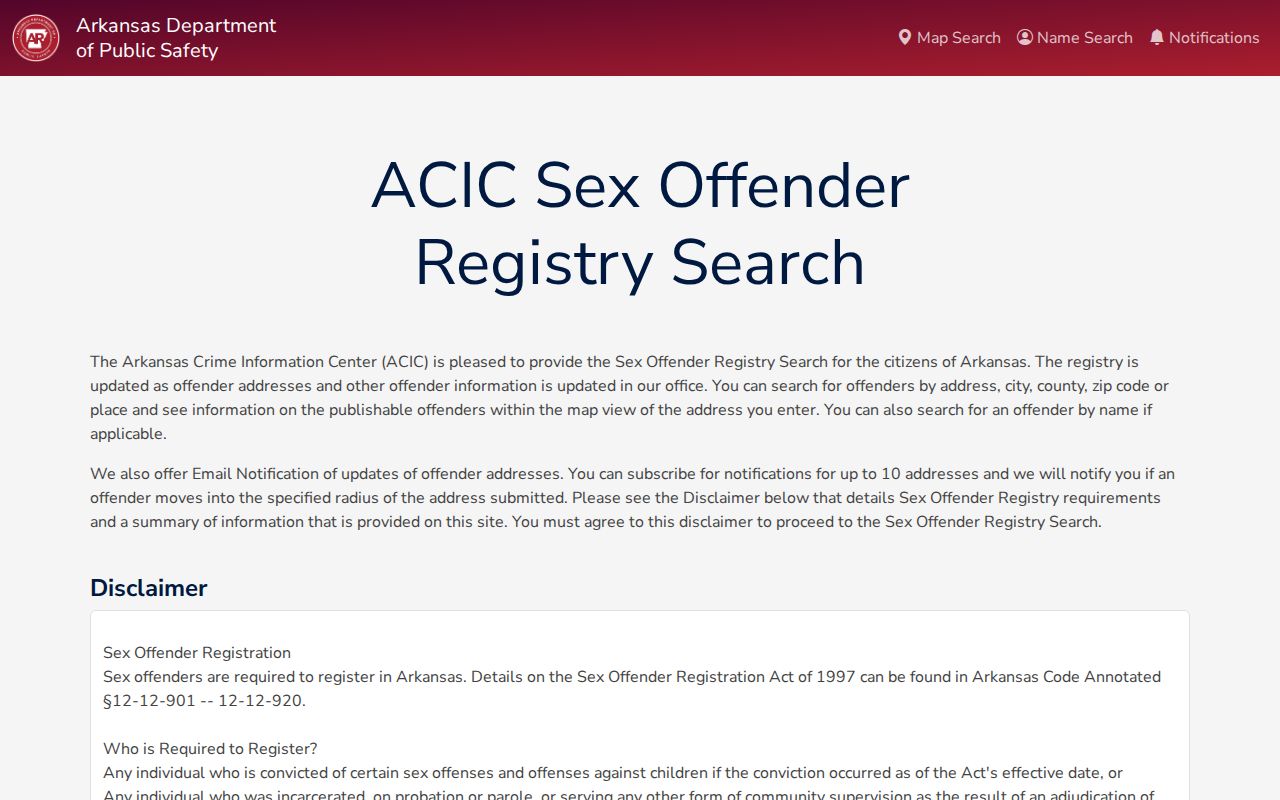
Its separate paths help users choose the correct Arkansas sex offender lookup method.
Note: Save the search date because ACIC updates Arkansas registration information as local agencies report changes.
What an Arkansas Registry Profile Lists
An Arkansas public profile can identify a registrant and explain the basis for public notice. The portal can show names, aliases, a current photo when available, birth date, sex, race, height, hair and eye color, and other marks. It may also show a registered residential location, county, city, ZIP, risk level, registration or compliance status, and qualifying offense information. Profiles vary, so a field seen once is not promised on every Arkansas record.
| Name & Aliases | Primary identity plus published alternate names used to distinguish matches. |
|---|---|
| Photograph & Physical Description | An image when available, birth date, sex, race, height, hair, eyes, and identifying marks. |
| Registered Address | The residential address or mapped location at the detail Arkansas law permits. |
| Offense & Conviction Details | Qualifying offense, jurisdiction, and conviction or adjudication facts when published. |
| Level / Tier | Arkansas Level 1, 2, 3, 4, or an assessment-related status. |
| Compliance Status | Registration status and local agency context available on the profile. |
Some private Arkansas registration details never belong in a public lookup. The full Arkansas file can contain fingerprints, palm prints, DNA data, account identifiers, device details, travel documents, and supervision information. A public Arkansas registry profile is not the whole Arkansas government file.
Note: Not every Arkansas profile has a photograph or every field found on another public profile.
Arkansas Registry Address Alerts
The Arkansas notification path supports continued neighborhood awareness. Enrollment is free and requires email verification. A user may save up to 10 Arkansas addresses and select a quarter-mile, half-mile, one-mile, or two-mile zone. This formal radius belongs to the Arkansas alert tool. The live Arkansas map itself works from visible bounds. That distinction keeps a map view from being mistaken for a fixed legal distance check.
Alerts report registry changes near a saved point. They do not prove where a person is at a given moment. Address data can change as a registrant reports a move and the local agency sends the update to ACIC. Save the notice and recheck the official profile. For a suspected compliance problem, contact local law enforcement. Use emergency services only when danger is immediate.
Registry Levels and Requirements in Arkansas
Arkansas uses Levels 1 through 4, not the federal Tier I through Tier III terms, as its public risk scheme. The Community Notification Assessment process assigns the level. Refusal or failure to cooperate can produce a default Level 3. The level changes the reach of public notice, but it does not by itself set a fixed end date. Lifetime categories and the petition route come from Ark. Code § 12-12-919.
| Level / Tier | Duration | Verification Frequency |
|---|---|---|
| Level 1 | Statutory duty; eligible non-lifetime person may petition after 15 years | Generally every six months |
| Level 2 | Same lifetime or non-lifetime analysis; level alone does not fix duration | Generally every six months |
| Level 3 | Lifetime only when a separate lifetime category applies | Generally every six months |
| Level 4 | Lifetime registration | Every 90 days |
| Other non-lifetime registrant | May petition the sentencing court after 15 qualifying years | Current agency instructions control |
A successful Arkansas 15-year petition is not automatic. The Arkansas court must find an offense-free period and no likely safety threat. The prosecutor, ACIC registry, and Arkansas assessment unit receive advance notice. A denied petition generally cannot be filed again for three years. Ending Arkansas registration is distinct from sealing the conviction.
Arkansas Registry Numbers in Context
ACIC reported 20,396 registered offenders as of May 13, 2026. Its assessment snapshot listed 1,069 at Level 1, 8,275 at Level 2, 5,431 at Level 3, 500 at Level 4, and 5,120 unassessed. Those detail rows total 20,395, one below the headline. The source's small discrepancy should remain visible rather than being silently repaired.
A separate Arkansas annual status table reports 20,246 registrants for 2025. That table divides the total among compliant, delinquent, incarcerated, out-of-state, unknown-address, deported, incapacitated, and outside-the-country statuses. These are not all Arkansas public profile counts. The statewide Arkansas public list has narrower rules, and unassessed does not mean unregistered. The figures show the scale of Arkansas registry work, not a count of people currently present at mapped homes.
The official Arkansas assessment rule provides the setting for community-notification levels.
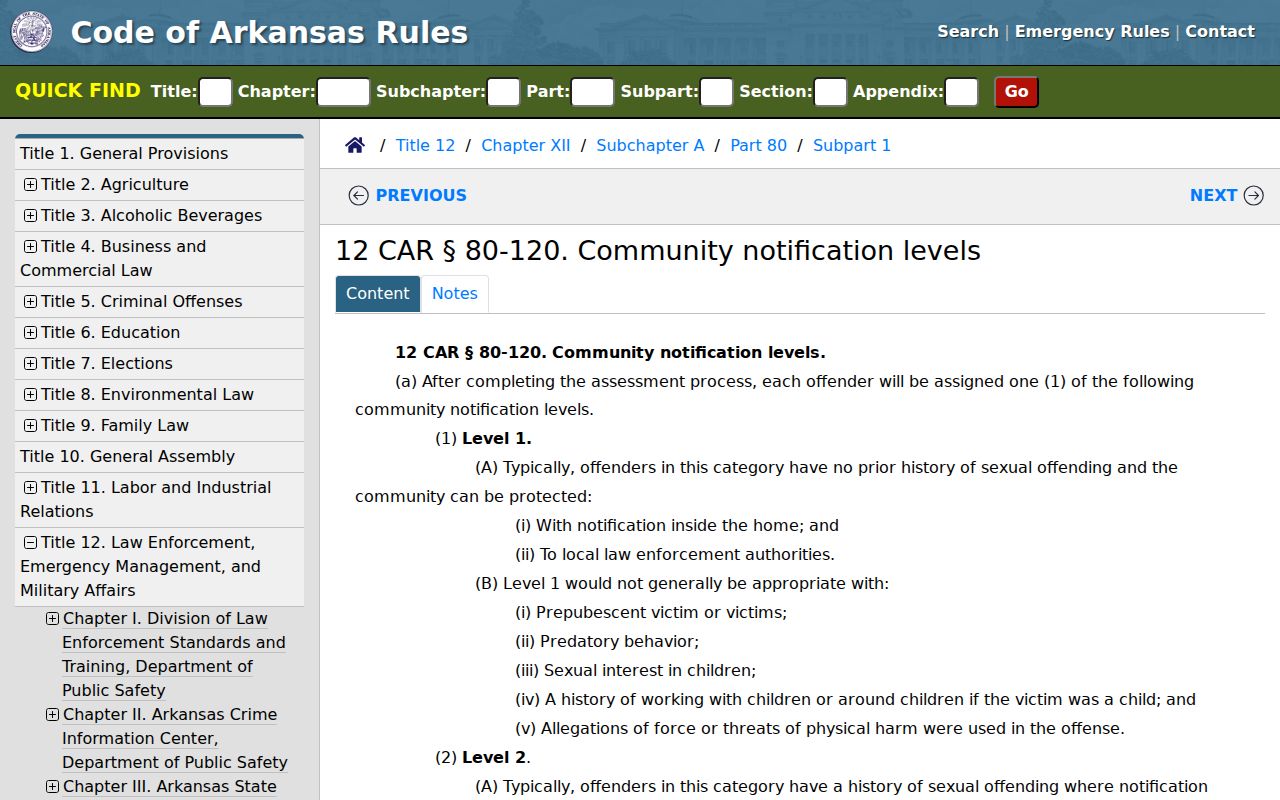
The rule confirms that Arkansas levels describe assessed notification risk, while duration follows a separate statutory test.
Arkansas Registration Starts Locally
Arkansas courts, corrections staff, and local agencies each play a part. At adjudication, the sentencing court identifies the duty and forwards the registration form. Correction and Community Correction staff handle covered people in their custody or supervision. Local law enforcement schedules in-person reporting, records a current photo and identifiers, and sends verified information to ACIC. A move from another jurisdiction generally must be reported within three business days under current Arkansas rules.
Arkansas address changes normally must be reported before a move. An unexpected emergency change has a shorter after-the-fact deadline. A conditional $250 Arkansas DNA Detection Fund fee can apply to a new or out-of-state registrant when the needed DNA sample is not available. It is not a universal annual fee. Failure to register, verify, report covered changes, cooperate with assessment, or give truthful information can be an Arkansas Class C felony.
For counter practices, appointments, or a compliance question, choose the correct office through the directory of Arkansas counties.
Arkansas and National Registry Searches
ACIC is the source for Arkansas registry detail. The local registering agency handles verification and community notice. The U.S. Department of Justice's National Sex Offender Public Website adds a cross-state search across participating jurisdictions. A national match should lead back to the source jurisdiction's profile because publication rules, update timing, and assessment language differ.
The national service shows why wider coverage does not mean deeper Arkansas detail. It is useful when an Arkansas person or place question crosses state lines. ACIC remains the better source for Arkansas status and level language. The national registry search supplies a routing view of participating systems.
For the underlying case, use Search ARCourts and the county clerk. For present state custody or status alerts, use ADC Inmate Search or Arkansas VINE. Those tools answer different questions and do not replace the registry.
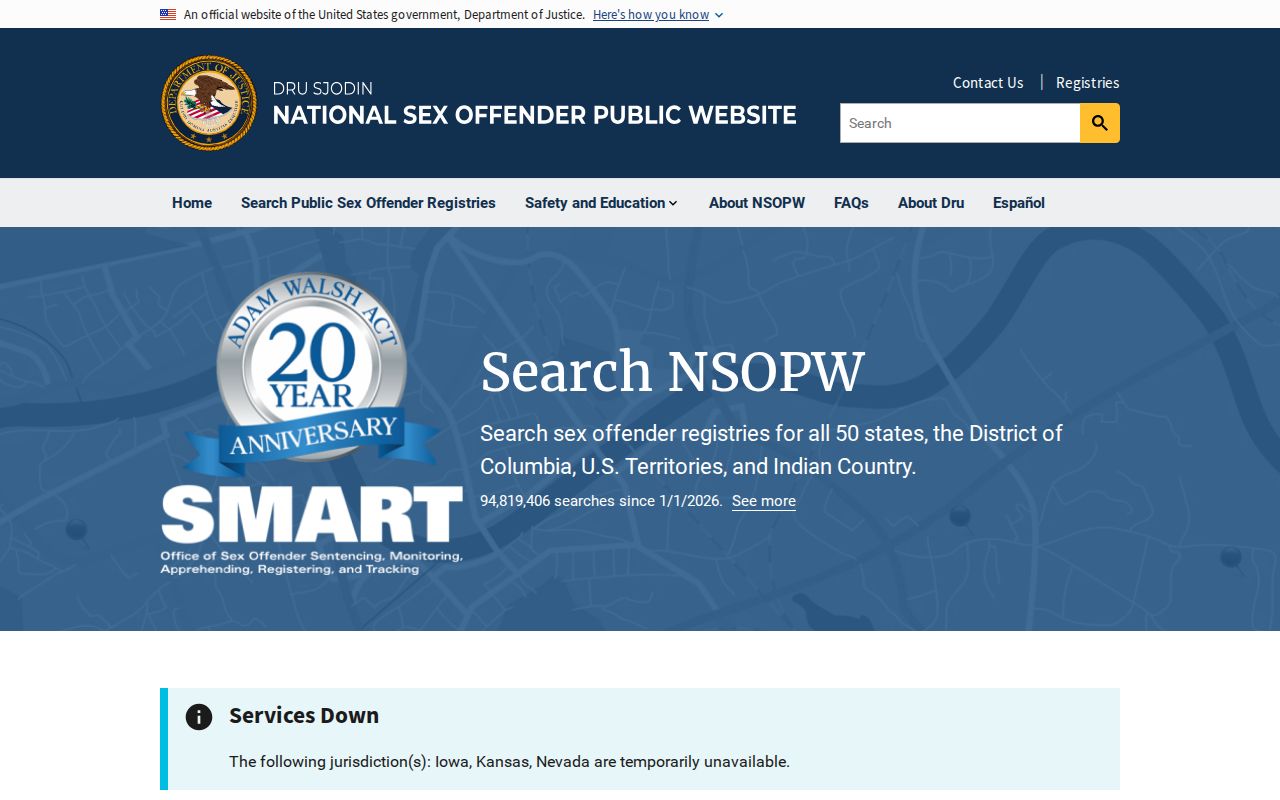
Use the wider search to find the source, then confirm Arkansas information through ACIC and local officials when needed.
Using the Arkansas Registry Lawfully
Arkansas registry information supports personal and family safety planning, address awareness, and informed contact with public agencies. Read the offense, status, and risk level with care. Never infer more than the official profile states. Under Ark. Code § 12-12-913, disclosure and community notification do not authorize threats, harassment, intimidation, trespass, property damage, or vigilante contact.
Arkansas restricts some Level 3 and Level 4 residences near schools, parks, youth centers, and daycares. A map pin cannot prove a violation. Legal distance depends on property lines, place type, exceptions, prior ownership or occupancy, and the person's category. Report a concern to law enforcement rather than approaching the address.
Misuse is a crime. Arkansas registry data is for safety awareness. Do not harass, threaten, intimidate, or commit an offense against a registrant or household.